

Comœdiæ: Andria, Eunuchus, Heautontimorumenos, Adelphi, Hecyra, Phormio, ex emendatissimis ac fide dignissimis codicibus summa diligentia castigatae (…).
Venice, Girolamo Scoto, 1545.
2 parts in 1 folio volume, (14) ff., 154 ff., 117 ff., (4) ff., 1 blank f. Half vellum with corners (18th century), boards covered in patterned paper, smooth spine with red morocco title label (minor losses to the title label, small stains on the first two leaves, angular tear without text loss at the bottom of leaf 61, ex-libris erased at the bottom of the title leaf).
Dimensions: 32.3 x 22.4 cm.
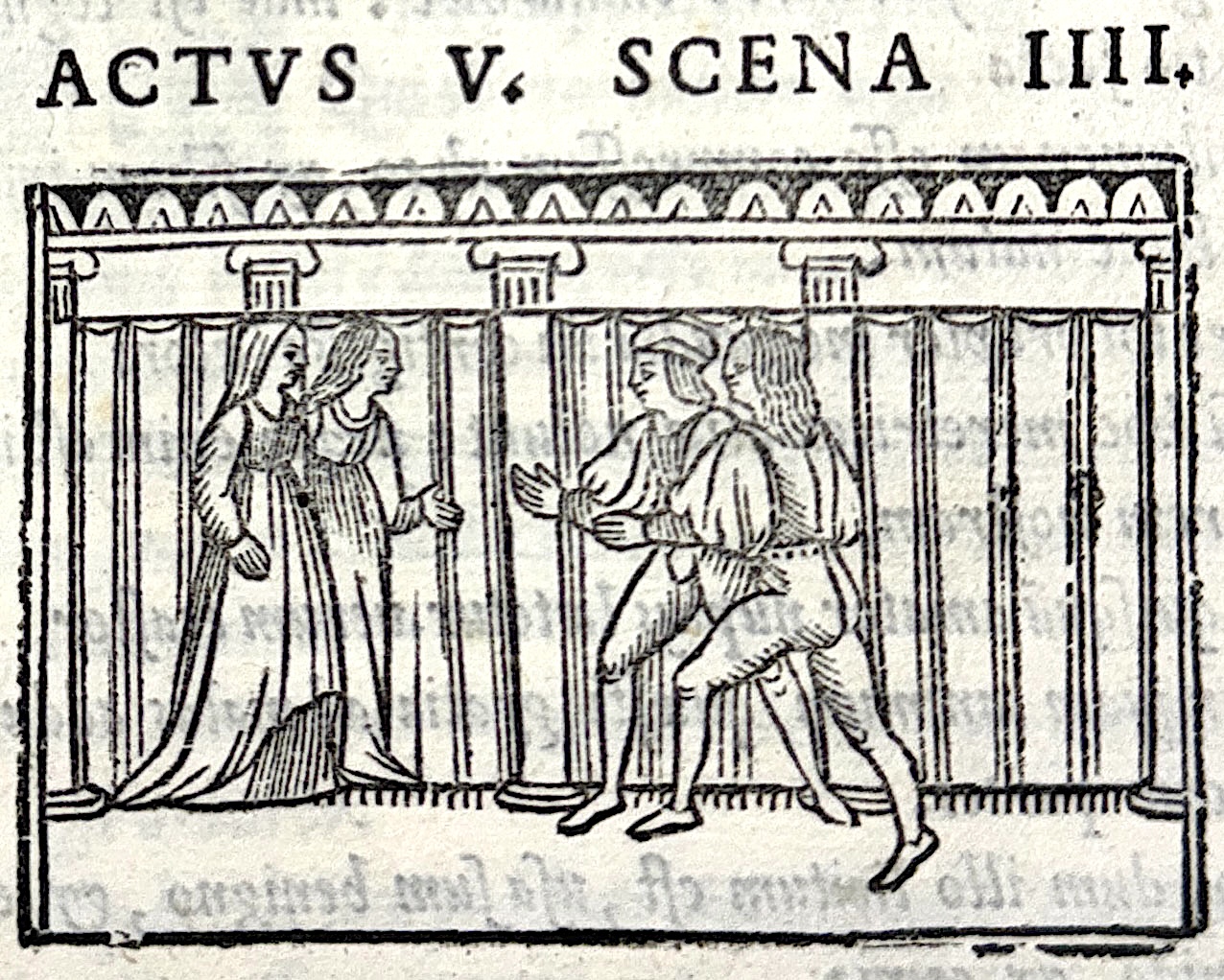
A beautiful Venetian edition printed in italics and illustrated with 149 woodcut vignettes.
The engravings depict scenes from Terence’s plays performed by actors in Renaissance costumes.
This edition belongs to the “encyclopedic” publications of Terence that compile numerous ancient and humanist commentaries, including those of Erasmus, Donatus, Calphurnius, Melanchthon, Gouvea, Barlandus, Marsus, Rivinus, Dolet, Glareanus, and Hegendorf (for arguments), as well as Latomus. A poem by Étienne Dolet, celebrating the purity and elegance of Terence and contrasting it with the vulgarity of Plautus, is reproduced on the verso of the title page.
A CENSORED COPY
The names of Erasmus and Melanchthon have been systematically blacked out by an inquisitorial hand following the principles of Tridentine censorship. These two humanists are listed in the Index Librorum Prohibitorum, first published in 1559.
EXTENSIVELY ANNOTATED COPY
The first reader (an Italian from the early 17th century) engages with the humanist commentaries and tools: citing Henri Estienne’s Thesaurus Graecae Linguae for the Greek adverb mala in its superlative form (malista) (f. 24v); referring to Caspar Schoppe’s edition of the Carmina Priapeia (Ingolstadt, 1606) (f. 68v) to elucidate a passage from the beginning of Eunuchus. His references often form an elaborate chain: in the Andria (II, 3, f. 29r), regarding the plight of unsupported women who are easy to exile, he adds a reference to Aulus Gellius’s Attic Nights (Lib. 12, Cap. 7), concerning a woman accused of poisoning and sent by Proconsul Dolabella to the Areopagus of Athens. This complements Guillaume Budé’s reference to Valerius Maximus provided in the printed commentary. Fluent in Greek, this reader invokes Sophocles’s Antigone to explain a Greek construction, quoting and then translating several verses into Latin.
The second reader, an 18th-century intellectual, focuses more on rendering the text into Italian. For example, in a passage from the Andria (II, 2), he highlights the ideal of the honest man: “io non penso che sia azione di galantuomo, quando non si fa servizio alcuno pretendere che uno abbia a rimanerli obbligato” (f. 24v). In the margin of a passage from Heautontimorumenos (The Self-Tormentor), he reflects on the ancient alliance between poetry and music, citing a 1738 lecture by Antonio Volpi in Padua, later published in 1740: “In ancient times, poets were also musicians. See Volpi in his Acroasis (= lecture) given in Padua in 1738, p. 10” (f. 125r). Occasionally, he also cites the classics, particularly Horace, such as in f. 52r where he references a line from the Odes (II, 4): “the altar wreathed with chaste vervains desires to be sprinkled” (ara castis vincta verbenis).
A Fascinating Annotated Copy of This Lavishly Illustrated Edition of Terence
Offered by Librairie Nicolas Malais
$5000
Leave a Reply