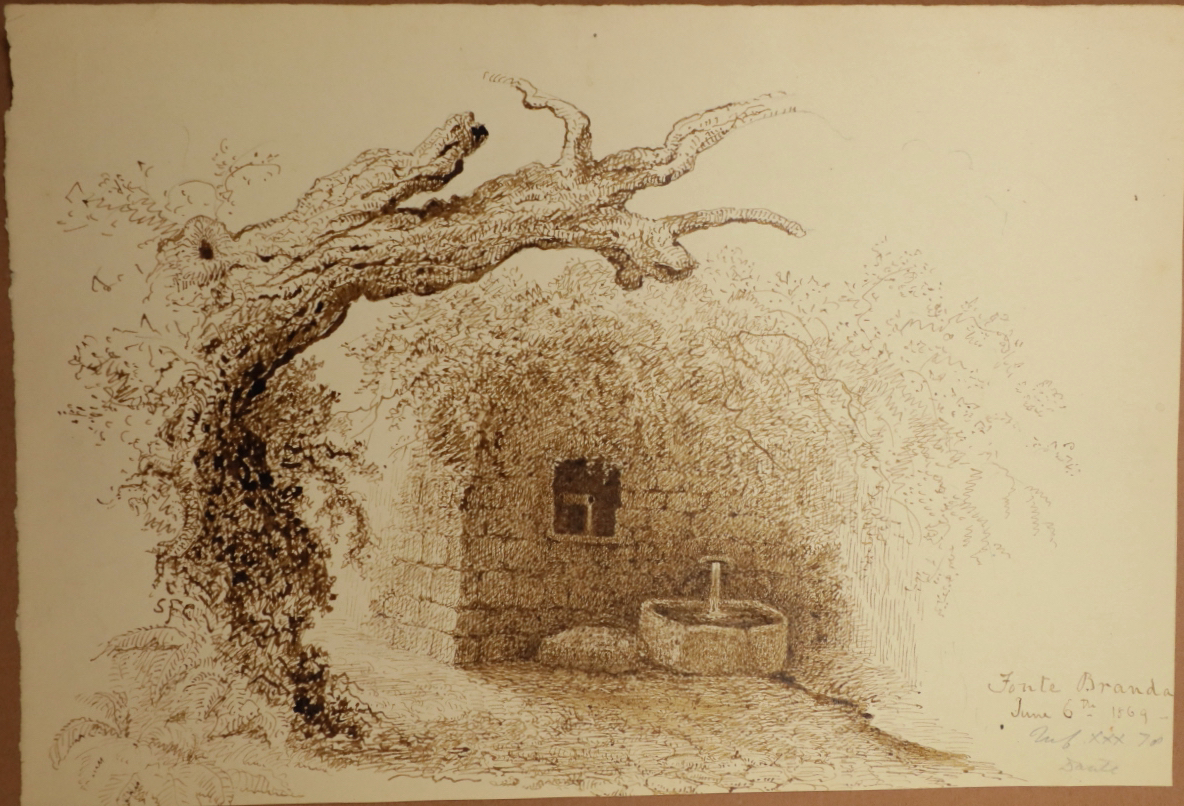


Size of the album 10,5 x 8,5 inches, half leather restored at the top of the spine, 61 original ink (mostly) drawings with identified location, some signed other initialed by the artist. The drawings include Illinois (2), Sault Ste-Marie (2), New Brunswick and Nova Scotia (15), Italy and Switzerland for the others. Many are related to the life of Dante, a major subject of interest of the artist. The size varies from full page to 53 x 25 cm for the smallest. Drawings are in very good condition. The seven engravings, possibly after works of the artist, have some foxing. The album was bequeathed by the artist to her nephew, Thomas C. Clark, at her death in 1896, as inscribed.
Sarah Freeman Clarke was a Boston-born landscape painter, illustrator, author, traveler, student of Dante, and founder of the town library in Marietta, Georgia. With little formal education, she made antebellum Boston her classroom, finding mentors among friends, family, teachers, and reformers. She became active in the city’s artistic and intellectual circles, studying painting with Washington Allston; exhibiting her work at the Boston Athenaeum; taking part in Margaret Fuller’s Conversations for women; illustrating Fuller’s first book, Summer on the Lakes; and contributing to The Dial, the journal founded in 1840 by members of the Transcendentalist Club. Beginning in the 1840s and for extended periods after the Civil War, Clarke lived in Italy, where she continued her landscape painting and studied Dante, later writing about his life and work for Century magazine. The town library in Marietta, which opened in 1893, grew out of the book collection Clarke had assembled over many years of travel and study. Family background and early years Sarah Freeman Clarke was born on January 21, 1808, in Dorchester, Massachusetts, the second of six children and the only daughter of Samuel Clarke (1779-1830) and Rebecca Parker Hull Clarke (1790-1865). The Hulls and the Clarkes were long-established New England families, of shipmasters, merchants, lawyers, doctors, clergy, and soldiers.
She attended talks by Ralph Waldo Emerson (1803-1882), then beginning his career as a lecturer, and may have met him as early as 1834 at a gathering after one of his lectures. As her friendship with Emerson deepened, Sarah came to hold him in the highest esteem, telling James she felt “the compliment of being addressed with the respect due to a human being and a living soul.” She would later credit his call to “satisfy the wants of your own soul…[regardless of] the prejudices of society” as helping her to finally define herself as an artist.
Offered by Librairie Michel Morisset
$10,000
To purchase, contact mm@librairiemichelmorisset.com

Leave a Reply