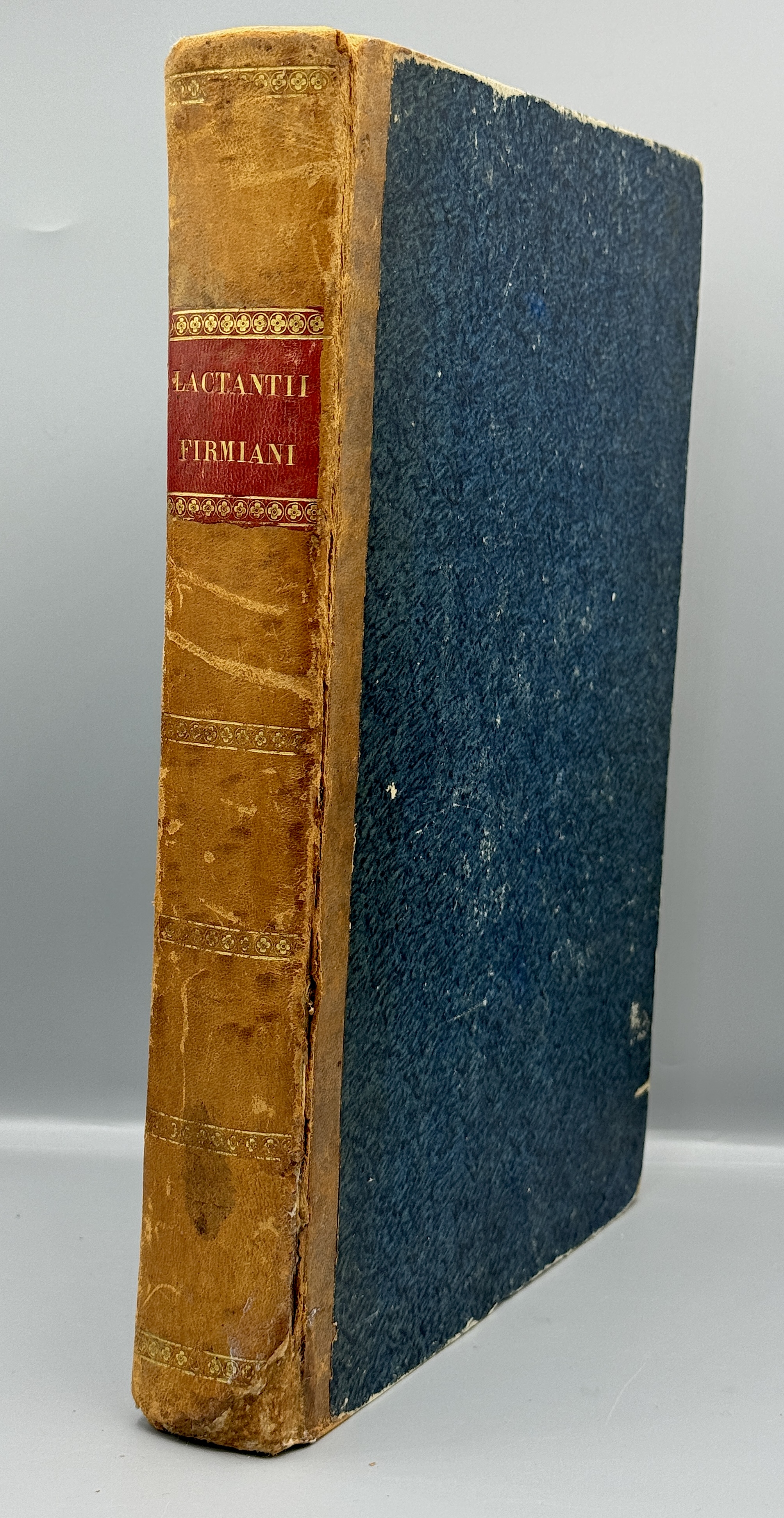


Folio. (213) leaves (signatures: a2–9, b–d8, e10, f–m8, M8, N6, n–r8, s–t6, u–x8, y6, z8, &8, £10). Lacking leaf a10 (table); a1 (blank) not preserved. Early 19th-century half blond calf, smooth spine decorated with red long-grain morocco title label. Hinges restored, rubbing on spine, corners worn, small marginal dampstains, worming, slight foxing on the first and last leaf, small tear on leaf g iiii. Some initials and paper flaws restored. Dimensions: 29.7 x 19.2 cm.
References: ISTC il00008000, GW M16561 (with incorrect collation). BMC V, 251. Hain-Coppinger, 9813. Goff, L-8. The work bears a printing date at the colophon of March 12, 1478. The Julian calendar, still used in many regions of Europe, marked the end of the year 1478 on March 24, with the year 1479 beginning on March 25 (March 25 being the supposed date of the Annunciation of Christ). The mention of Doge Giovanni Mocenigo (elected in May 1478) in the work leads some bibliographers to date it to 1479 following a printing error in the colophon; this correction is probably unwarranted, as the printer evidently used the Julian calendar ending the year on March 24, 1478, with March occurring after and not before May 1478!
–
Provenance:
- Anonymous contemporary reader, 1486: Ownership note dated Saturday, January 28, 1486, on the verso of the last leaf (“die sabbati xxviii Januarii anno natalis dominice Christi veri dei nostri IIII° & octagesimo sexto supra millesimum“).
- Another anonymous reader, early 16th century.
- Old library shelf mark (first pastedown).
Language of annotation: Latin.
Bibliography: L. Panizza, “Lorenzo Valla’s De vero et falsoque bono, Lactantius and Oratorical Scepticism,” Journal of the Warburg and the Courtauld Institutes, 1978. A. Grafton, “The Margin as Canvas: A Forgotten Function of the Early Printed Page,” in Impagination—Layout and Materiality of Writing and Publication, De Gruyter, 2021, pp. 185–207.
–
Incunable edition of the Divine Institutions by the Christian orator and philosopher Lactantius (c. 250–c. 325).
This is the only book printed by Andrea de Paltasichis, a Dalmatian printer, in association with Bonino de Boninis of Ragusa. Lactantius, nicknamed the “Christian Cicero,” is the first to expound Christian doctrine in Latin. The Renaissance rediscovered him and took particular interest in his doxographical content. Very close to Emperor Constantine, he was called to Trier to be the tutor of his son Crispus. “Neglected during the Middle Ages apart from loci on Seneca, Lactantius attracted interest once again in the Italian Renaissance” (Panizza, p. 83).
Copy rubricated, with initials in red and blue. On f. b1r, the large initial at the beginning of the book has been erased and replaced by a more modest capital in light brown ink. Notably, leaf y1 was imperfectly inked, and a contemporary hand has filled in the gaps. At the end of the work, after Lactantius’s poem The Phoenix, extracts of poems on the same theme are printed (f. &8r): some verses from Ovid’s Metamorphoses, six lines from Dante’s Inferno (XXIV), and a poem by Venantius Fortunatus. It appears the rubricator misunderstood the first word of Dante (“Cossi” = “Così”) and mistakenly traced the initial “P” (“Possi” (sic)).
Copy extensively annotated by a contemporary reader, from 1486 onwards
Scholarly annotations
Our reader precisely dated the acquisition of the volume to Saturday, January 28, 1486, on the verso of the last leaf: “die sabbati xxviii Januarii anno natalis dominice Christi veri dei nostri IIII° & octagesimo sexto supra millesimum“.
A reader of Plato, he deeply annotates the work and does not hesitate to cross-reference his readings. He provides references, makes remarks, and compiles notes. He highlights passages on the Sibylline Oracles (f. l7v) and compiles a list of the different sibyls (Delphic, Erythraean, etc.) on f. b6r—Lactantius being a key author in transmitting this knowledge, even if to refute it. The annotator shows interest in passages on Orpheus (Book I, chap. 13, f. b6r), Agamemnon, and the Trojan War (chap. 23, f. d8v). He cites Plato and Cicero (f. t1v). He is particularly attentive to moral considerations, noting, for example, that “there is no greater victory in the world than to conquer oneself, that is, anger and sensuality, namely lust and the other seven mortal sins” (nulla in mundo major reperitur victoria quam vincere se ipsum, hoc est iram et sensualitatem. Videlicet luxuriam et alia septem mortalia peccata, f. b8v).
A reader from the early 16th century has also added some notes: on the verso of the last leaf, there is a moral reflection on friendship and relationships with friends and enemies, inspired by Cicero. Epitaph formulas have also been inscribed: “Hic jacet Helisabet si benefecerit habet” and “Hic jacet in tumulo Johannes filius“.
–
11 drawings & numerous manicules
Our reader added surprising sketches and grotesque profiles in the margins. Some reflect his mood during reading; others are true illustrations responding to the text.
In a passage of Book VII where Lactantius describes at length the Dies Irae, the Day of Judgment, he draws a trumpet accompanied by a manicule pointing to the passage: “And lest any evil be lacking for men and earth, a trumpet will be heard from heaven, as the Sibyl announces in this way (…)” (Ac ne quid malis hominum terraeque desit, audietur de caelo tuba, quod hoc modo Sibylla denunciat dicens (…), f. t3v).
In a discussion on disinterested charity, he sketches in the margin a face with a calm gaze (Book VI, chap. 12, f. p5r), sharply contrasting with the scowling gargoyle or corbel profile guarding the margin of chap. 18 of Book IV, which speaks of Christ at the outrages foretold by the Old Testament: “Israel will be ruined and covered with reproach, and this house will be deserted (…)” (f. m3v).
The power of the Cross is materialized in the margin by a Calvary dominating the page (f. M1v), directly responding to Lactantius’s text.
In addition to the 11 sketches and profiles, the annotator employs an inventive range of large manicules, with pointing index fingers, stylized cuffs, and sometimes depicting an arm movement emerging from the margin (cf. f. m6r).
These visual annotations are particularly interesting as they lie at the confluence of medieval tradition and Renaissance practices. A sort of visual gloss, these sketches are a form of textual exegesis—a “distinctive kind of visual explication of texts,” according to Anthony Grafton (2021).
–
A remarkable copy, rubricated, embellished with drawings, and annotated by a contemporary reader
Offered by Librairie Nicolas Malais
$15,000
To purchase, contact librairie–nicolas@orange.fr
Leave a Reply