PRECIOUS COPY FROM BUFFON’S LIBRARY


Octavo, (4) ff., 716 pp., (2) ff., 24 pp. Contemporary brown calf binding, spine with raised bands and gilt decoration, title label in aged red morocco (headcaps and corners worn, some rubbing on spine, leather missing at head of rear cover, title page somewhat soiled, slight water stains affecting the plates).
References: Dictionary of Scientific Biography, XII, 302.
Provenance:
- Georges-Louis Leclerc, comte de Buffon (“Leclerc de Buffon 1733,” handwritten ex-libris vertically inscribed on the title page).
- Mirabeau (Catalogue des livres de la bibliothèque de feu M. Mirabeau l’aîné, 1791, sale in February 1792, missing from the catalog).
- Charles-Louis Trudaine de Montigny (1764–1794), counselor to the Parlement of Paris (Catalogue des livres de la bibliothèque de feu Charles-Louis Trudaine l’aîné, Year X-1801, no. 454). He maintained libraries both in Paris at 31 rue Taitbout and at the Château de Montigny (Seine-et-Marne).
Bibliography
- J. Roger, Buffon, Fayard, 1989.
- A. Dide, “Mirabeau bibliophile,” in La Révolution française, Paris, Charavay, 1884, vol. VII, pp. 253–258.
- F. Weil, “La correspondance Buffon-Cramer,” Revue d’histoire des sciences, XIV, 1961, pp. 97–136.
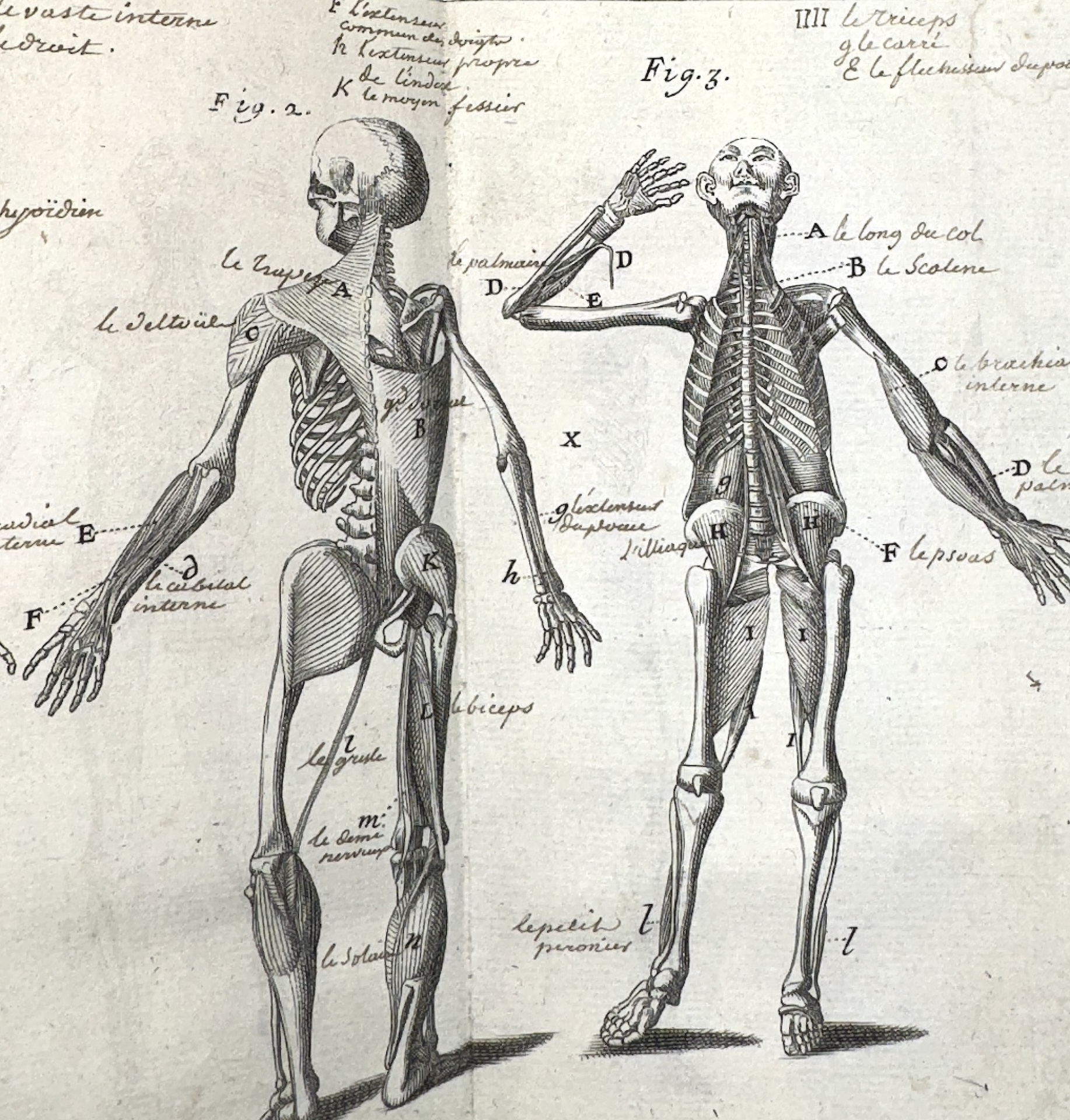
First edition of the French translation of Heister’s Compendium anatomicum, illustrated with 13 folding plates bound at the end. This work was extensively revised and edited by Jean-Baptiste Sénac of the Montpellier School of Medicine, first physician to King Louis XV.
A Precious Copy from Buffon’s Library
The handwritten ex-libris on the title page, inscribed “Leclerc de Buffon,” dated 1733, indicates a youthful acquisition by Buffon. According to Françoise Weil, “it is only from 1734 onwards that the signature ‘Buffon’ consistently appears” (Weil, 1961, p. 97). This purchase coincides with Buffon’s early years in Paris, where he resided from 1732 at the home of Gilles-François Boulduc, first apothecary to the king. It was also in this year that Buffon successfully presented his paper Sur le jeu du franc-carreau to the Academy of Sciences, introducing differential and integral calculus in probability (see Roger, pp. 40–41). He became a member the following year.
Buffon’s library was largely dispersed; notable examples bearing his ex-libris include two works by Stephen Hales, an author Buffon translated into French, held at the Municipal Library of Lyon (Rés 809977, with an ex-libris from 1739) and the Montpellier Medical Library (Ee 56 octavo, with an ex-libris from 1744).
A Heavily Annotated Copy
This volume, signed by Buffon on the title page, also contains numerous handwritten marginal notes in brown ink, in French and Latin (with occasional Greek terms lacking accents or breathings).
Although there are indications that the annotations may have been annotated by Buffon himself—such as his signature on the title page and the observation by Auguste Dide that “most volumes from Buffon’s library were covered in numerous notes written in Buffon’s own hand”—we cannot definitively confirm or refute his authorship of these annotations. Certain similarities are noteworthy: the slanted “d” (bottom of p. 80) and the distinctive formation of “ff.” with an upward flourish between the strokes (p. 81).
Buffon’s studies in medicine at the Faculty of Angers from 1728 onward may lend some credence to this possibility. In his Histoire naturelle de l’Homme, Buffon even referenced this work, Anatomie d’Heister, stating: “Of all the works I have read on physiology, I have found none that seemed better constructed or more in accordance with sound physics.”
The annotator provides etymologies for technical terms: on the “saddle,” an eminence for the junction of the ethmoid bone, they note, “Latin: small seat. The sphenoid bone’s processes resemble a horse’s saddle” (p. 11). Similarly, for the sternum, they write the Greek term followed by “anterior part of the chest” (p. 23). There are references suggesting a naturalist’s approach, such as in relation to the mesentery and membranes: “this is what is called the ‘calf’s sweetbreads’ in animals” (p. 141). The annotator also meticulously annotated anatomical plates IX and X bound at the end.
Later Provenance and Bibliophilic Significance
The volume later belonged to Mirabeau, who acquired a significant portion of Buffon’s library. Auguste Dide provides details of this acquisition: “This collection included books that had belonged to the naturalist Buffon. In 1790, Mirabeau purchased the entire library of the eloquent author of Histoire naturelle. This library was valuable not only for its numerous rare books but also because most of the volumes were covered with copious notes in Buffon’s handwriting” (Dide, 1884).
A purchase note from the Mirabeau sale in 1792 was inscribed by Charles-Louis Trudaine de Montigny, a wealthy bibliophile who acquired the volume and noted its significance: “Buffon’s copy, signed by him / 1 livre tournois 10 sols at the Mirabeau book sale, Thursday, February 16, 1792, unnumbered.” A natural history enthusiast, Trudaine acquired several books from Buffon’s library at this sale, including the aforementioned examples in Montpellier and Lyon. His widow organized two sales of his library, and this volume appeared in the first (1801).
A Precious Annotated Volume from Buffon’s Library.
Offered by Librairie Nicolas Malais
$9000
To purchase, contact librairie–nicolas@orange.fr
Leave a Reply