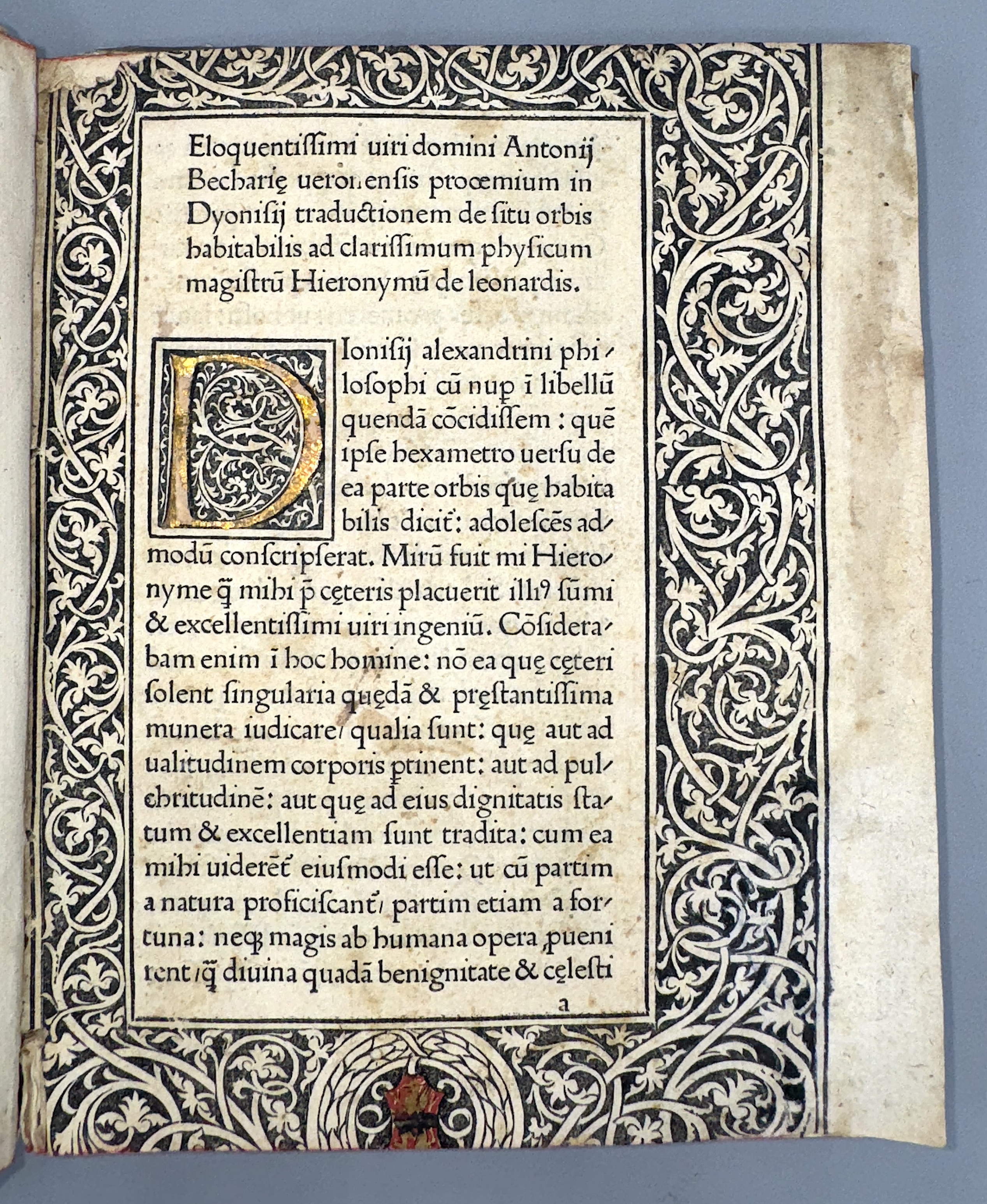


Quarto, (41) ff. (a-d⁸, e¹⁰). 18th-century vellum binding, smooth spine with gilt title and date (the last blank leaf not preserved, small losses to the vellum on the spine, and a snag at the top of the lower board; slightly trimmed margins after the 18th-century rebinding, affecting notably the coat of arms where the base is missing, as well as some annotations; losses in the border of the first leaf with manuscript restorations; reinforcing strips on the first and last leaves; scattered worming; minor foxing). Dimensions: 17.6 x 14.2 cm.
References: GW 08426. ISTC id00253000. Goff D253. Hain *6226.
Provenance:
- Cramer family, from Swabia: painted coat of arms, gules with a golden griffin (standing on a green mount) with a sable fess argent over the whole (Rietstap, Armorial général, vol. I, 1861, p. 278, col. 2).
- Maggs, Catalog no. 1005, Ancient, Medieval and Modern, April 1980, no. 204.
Rare first separate edition of the description of the world by Dionysius Periegetes, a didactic geographical poem first published in verse form in a 1470 edition of Priscian’s works. The editio princeps in Greek only appeared in 1512. This is also the first edition of the Latin prose translation by Antonio Beccaria—much rarer than the second edition, printed in Venice in 1478 by Franciscus Renner of Heilbronn.
Beautifully printed in Roman type, 25 lines per page, with an elegant arabesque border on the first leaf and a few woodcut initials—an innovation that became widely adopted. The initial on the first page is heightened with gold leaf.
The Description of the World by Dionysius Periegetes, an Alexandrian geographer active during Hadrian’s reign, served as a textbook in Byzantine schools and retained significant authority during the Renaissance, ranking alongside Strabo and Ptolemy in importance.
Antonio Beccaria’s translation, completed between 1453 and 1470, is preceded by a dedication to the Venetian physician Girolamo de Leonardi. Beccaria, a humanist and secretary to Ermolao Barbaro the Elder, bishop of Verona (identified in a marginal note of the dedication), benefited from intellectual exchanges within a brilliant circle. Beccaria likely used a Greek manuscript from the library of Matthias Corvinus, King of Hungary, to prepare his translation. The list of European provinces following the colophon was not penned by Beccaria: it is absent from both the Trento manuscript (possibly the presentation copy) and the Verona manuscript (see Parks and Cranz).
This copy originates from the library of the Cramer family in Swabia, bearing a painted coat of arms on the first leaf. This provenance possibly reflects the ties of Augsburg printer Erhard Ratdolt to Swabia, his home region. Ratdolt is known to have facilitated the exchange and shipment of books from Venice to his native Augsburg, where he returned after a decade in the Venetian Republic.
A reader from the first half of the 16th century annotated the margins with notes reflecting an attentive reading and interest in the geography of various parts of the world. Notably, this reader supplemented the book’s layout by adding marginal annotations to the undedicated portions. He also highlighted expressions concerning exotic locations: for instance, in the description of Babylon, he replaced the adjective ferax (“fertile”) with laeta (“pleasant”). Additionally, he recorded the rare word mercimonia (“merchandise”) in the margins.
A precious geographical incunable
Offered by Librairie Nicolas Malais
$9000
To purchase, contact librairie–nicolas@orange.fr
Leave a Reply