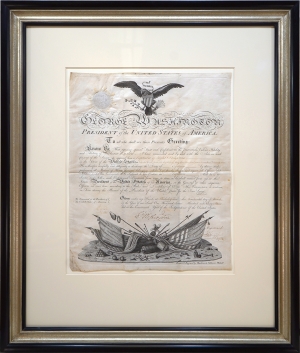


George Washington-signed military commissions are rare on the market, and we do not recall ever seeing a more attractive example.
Two weeks after his second inauguration, President Washington appoints William Winston as Captain of Light Dragoons. By the time Winston joined the army in the Northwest Territory, he had been promoted to command the entire cavalry of the new Legion of the United States. In that position, he fought at the Battle of Fallen Timbers, the decisive U.S. victory against the Native American confederation and their British allies in that area. William Winston began his military career in 1778 as a sergeant in Henry “Light Horse Harry” Lee’s 5th Virginia or 1st Continental Light Dragoons. That elite mounted infantry served with great distinction, notably at the battle of Paulus Hook, New Jersey, in 1779. Winston became a cornet that year, rising to lieutenant and adjutant in 1781, and serving until the end of the war. He rejoined in March 1792 as a lieutenant in the new Legion of the United States. Despite fears of a standing army, Congress authorized the creation of a legion of more than 5,000 soldiers and officers, though only 2,600 ultimately joined. At the time Washington signed this rare commission, just two weeks after his second inauguration, the nation’s main military challenge was securing peace with Native Americans (allied with the British, who still occupied the Northwest) along the frontier, the present-day border of Ohio and Indiana.
Washington nominated Winston for promotion to captain in May 1792, though the new commission was not issued until ten months later. In the meantime, Winston, who served as sheriff of Hanover County from 1786 to 1788, informed Secretary of War Henry Knox that he could not leave Virginia until the resolution of lawsuits involving slaves, horses, cattle, and hogs. Still, in May 1794, Washington nominated Winston for promotion to major in command of the Legion’s entire cavalry (Light Dragoons). The Senate confirmed the promotion a few days later. Winston did not finally join the Legion in the Northwest Territory until early in 1794, nearly two years after receiving his initial appointment.
On August 20, 1794, Winston fought at the Battle of Fallen Timbers, the decisive victory that marked the end of the Native American confederation in that area. “Mad Anthony” Wayne won large land concessions from the tribes in the 1795 Treaty of Greenville, securing much of the Midwest—including the sites of present-day Chicago, Detroit, Toledo, and Cleveland—for American settlement while promising that Indiana would be perpetually reserved for the tribes.
Winston was honorably discharged in 1796, the same year that the Jay Treaty officially ended the British occupation of the Northwest. Unfortunately, the promises to Native Americans in the treaty were never enforced. The treaty is considered a turning point in Westward movement that sparked the idea of manifest destiny.
GEORGE WASHINGTON. Document Signed, March 19, 1793, Philadelphia, Pennsylvania, appointing William Winston as Captain of Light Dragoons. Co-signed by Henry Knox, Secretary of War, and John Stagg, Chief Clerk of the War Department. Imprint at bottom, “Drawn and Engrav’d by Thackara and Vallance, Philada.” With paper seal of the United States. 1 p., 16 x 20 in., on vellum. Framed with rag mats and UV-filtered plexiglass to 29 x 34¼ in.
Offered by Seth Kaller
$55,000
Leave a Reply