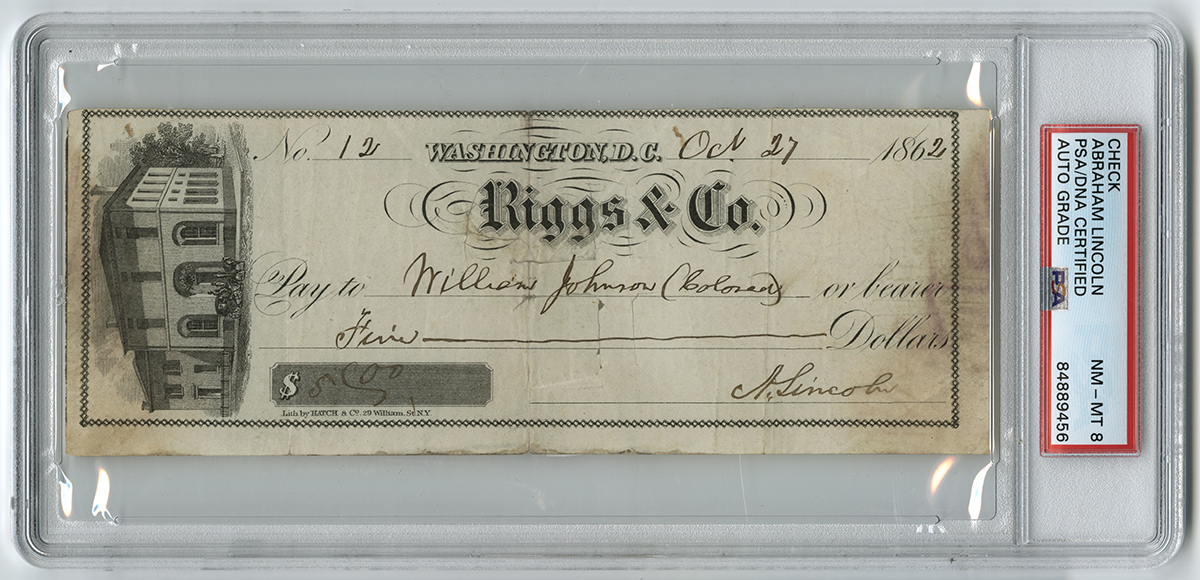


William Henry Johnson was a free black servant who accompanied the president-elect on his journey from Springfield to Washington, D.C., while Lincoln was under threat of assassination. Lincoln’s identification of Johnson as “Colored” would facilitate the latter’s cashing of the check.
On arrival in the capital, Lincoln found employment for Johnson stoking the furnace of the Executive Mansion, but the other African-American White House workers “objected to his dark complexion so vehemently that Lincoln had to find him another post.” Lincoln unsuccess fully tried to secure a job for Johnson with Navy Secretary Gideon Welles. On November 29, 1861, the president wrote to Secretary of the Treasury Salmon Chase: “You remember kindly asking me, some time ago whether I really desired you to find a place for William Johnson, a colored boy who came from Illinois with me. If you can find him the place [I] shall really be obliged.”
Chase hired Johnson as a porter at the Treasury with an annual salary of $600, and Johnson continued to serve Lincoln in a private capacity. He shaved and helped Lincoln dress each morning. In addition to barber, butler, groomer, fire-keeper, bootblack, and valet, Johnson served as a carriage driver and errand runner. Lincoln even trusted him to convey messages and, at times, significant sums of money.
In February 1861, a journalist described Johnson as “a likely mulatto, although not exactly the most prominent” and “yet a very useful member of the party. The untiring vigilance with which he took care of the Presidential party is entitled to high credit.”
A valet and bodyguard, Johnson accompanied Lincoln to the Antietam battlefield on October 2, 1862—two weeks after the declared victory finally allowed Lincoln to issue the Preliminary Emancipation Proclamation. It is interesting to speculate whether this check, dated 25 days later, was related to that trip.
Johnson’s most consequential trip was accompanying Lincoln to Gettysburg for the dedication of the Soldiers’ National Cemetery. There was a smallpox epidemic in Washington, D.C., at the time. Mary Lincoln did not accompany her husband on Nov. 18 because their son Tad had “varioloid,” a mild form of the disease. That morning, Lincoln made sure his indispensable man was with him, sending a brief note to Johnson’s supervisor at the Treasury: “William goes with me to Gettysburg.”
During the train ride, Lincoln looked “sallow, sunken-eyed, thin, careworn.” At the ceremony, he was described by reporters as “listless,” “sweating,” and “discouraged.” On the return trip, Lincoln went to bed in the presidential train car with a bad headache. Johnson kept him cool, bathing his forehead in cold water. Upon returning to the White House, Lincoln was diagnosed with varioloid. Recent research suggests his case was more serious. The president was quarantined and bedridden for three weeks. Johnson soon contracted the disease.
In January 1864, a regular correspondent for The Chicago Tribune came upon Lincoln counting out greenbacks for Johnson. The President explained, “This sir, is something out of my usual line; but a President of the United States has a multiplicity of duties not specified in the Constitution or acts of Congress. This is one of them. The money belongs to a poor negro [Johnson] who is a porter in one of the departments, and who is at present very bad with the small pox. He did not catch it from me, however; at least I think not. He is now in hospital, and could not draw his pay because he could not sign his name. I have been at considerable trouble to overcome the difficulty and get it for him, and have at length succeeded in cutting red tape…” The correspondent added, “No one who witnessed the transaction could fail to appreciate the goodness of heart which would prompt a man who is borne down by the weight of cares unparalleled in the world’s history, to turn aside for a time to succor one of the humblest of his fellow creatures in sickness and sorrow.”
Johnson died soon after. Lincoln purchased William’s coffin, sent money to his family, and paid off half of a $150 loan he had endorsed. In 1863, Johnson sought to borrow $150 from the First National Bank of Washington “to finish my little house.” The cashier, William J. Huntington, asked for a “responsible indorser,” and Johnson suggested President Lincoln, who accepted the responsibility. As the first $75 fell due, Huntington learned that Johnson had died. Later, Huntington met with Lincoln and offered to void the notes. Lincoln insisted on paying, but Huntington proposed that Lincoln pay one of the notes and the bank would cancel the other. Lincoln agreed. The cashier, when he gave the notes to Lincoln, said, “After this, Mr. President, you can never deny that you indorse the negro.” Laughing, Lincoln replied, “That’s a fact! But I don’t intend to deny it.” Johnson may have been buried in a grave in what became Arlington National Cemetery.
LINCOLN’S ILLNESS, AND GETTYSBURG By the 1860s, inoculation for smallpox was fairly common. The mortality rate for those who contracted smallpox was still around 30 percent. It was so highly contagious that Union soldiers were inoculated on entering the Army. The variola variant was as contagious as smallpox, but not as deadly or disfiguring. Variola’s symptoms include aches, fevers, and general malaise common to many other ailments. A rash or blotches that form blisters and scabs within days was its most distinguishing feature. While some scholars claim Lincoln was clearly ill when he left for Gettysburg, most believe he was incubating the illness, but that it didn’t fully manifest until his return to Washington. Having accepted the invitation, Lincoln kept the commitment. At the least, he was not feeling well, and he returned, feverish, and complaining of body aches. He took to his bed. His valet, William Johnson, was also ailing and immediately sent to his room. Within a few days, the telltale rash and pustules began to form.
There is some speculation that Lincoln had full-blown smallpox. Perhaps only the milder form was admitted to in order to lessen the anxiety of the public (and of Mary Lincoln). Both John G. Nicolay and John Hay, the president’s private secretaries, feared that Lincoln might die. According to assistant White House secretary William Stoddard, all members of the White House household, staff, and family (i.e., Mary and Tad) who had never been inoculated, immediately were.
The president remained in his rooms for several weeks after he returned from Gettysburg, and strict quarantine procedures were enforced. Normally besieged by people who wanted offices or favors or clemency, or merely to shake his hand, Lincoln quipped to his doctor, “now I have something that I can give to everybody.” He did not return to his office until shortly before Christmas. By then, scabs from his rash and blisters had abated, and he did not appear to have any visible facial scarring.
ABRAHAM LINCOLN. Partially Printed Document Signed, Riggs & Co. bank check, October 27, 1862, Washington, D.C. 1 p., 7½ x 2¾ in. Filled out and signed by Lincoln as president, payable to ‘‘William Johnson (Colored)” for $5.
Census — Only two other Lincoln checks to African Americans have appeared at auction in the last 40 years. In 1984, a $5 check Lincoln wrote to a “Colored man, with 1 leg” sold at Sotheby’s for $16,000, a huge price given that Lincoln’s original signature had been cut away, with a replacement signature patched in later. In 2005, a $5 check to “Lucy (colored woman)” sold for $55,200.
Offered by Seth Kaller
$175,000
Leave a Reply