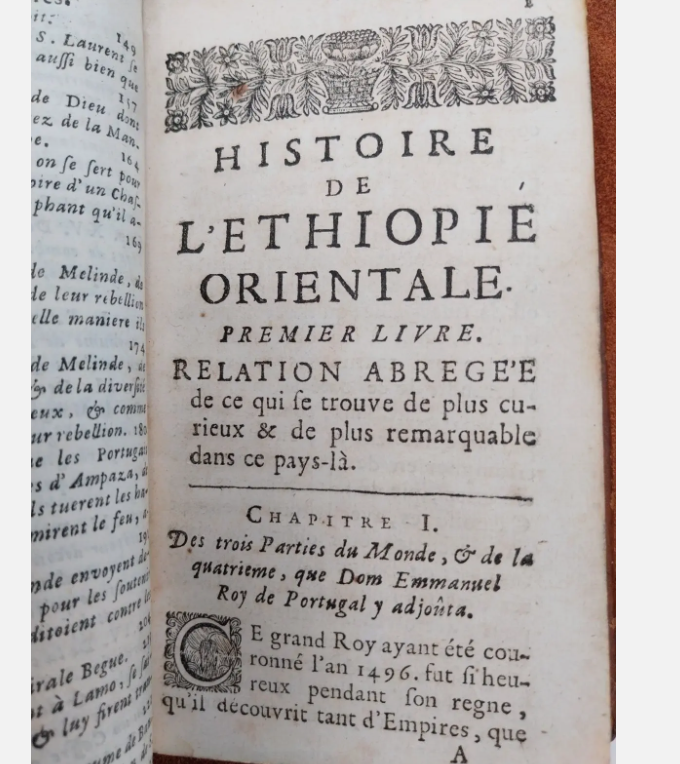


Histoire de l’Ethiopie Orientale, [translation from Portuguese by Dom Gaëtan Charpy, from a text by Jao Dos Santos published in 1609 in-folio].
Published at Jean de La Caille (Paris) in 1688.
In-12° with the arms of the Countess of Verrüe on both covers, heraldic elements between the ribs. Full calf with ribs, head cap leveled, headband present, tail cap perfect, traces of humidity on the leather at the tail, worn joints, three corners blunt, the 4th perfect. Endpapers and hinges perfect, marbled edges. The white endpaper recto and the title page are missing. Epistle (3 ff°) – Tables (2 ff°) – p. 1 to 237 – Permissions and approvals (3 p.) – white endpaper verso – 3 ff° – 2 ff° – 237 p. – 2 ff°
Small in-12° in good condition, with the arms of the Countess of Verrüe [silver, with a cross of sable, quartered with 4 diamonds of the same (Verruë); joined by Albert de Luynes, quartered by Rohan], shield pieces on the back [Lion rampant and macles].
Her arms are surmounted by the mention “Paris”, indicating that this work comes from her library at the hotel on rue du Cherche-Midi, the same one put up for sale in 1737 by Gabriel Martin with a catalog of 3,000 titles out of the 18,000 contained in the Countess’s library [Meudon + Paris].
As a reminder, the Countess of Verrüe, an icon of bibliophily, was Jeanne Baptiste d’Albert de Luynes (1670-1736), wife of Joseph de Scaglia, Count of Verrüe. She was the mistress of Victor-Amédée II, Duke of Savoy. She ended up taking refuge in Paris in 1700.
This edition is that of Jean de La Caille, the famous historian of printing. A first edition appeared in 1684 by Claude Barbin and André Cramoisy. The copy we are presenting no longer has its title page (and its white guard) [a defect that can be compensated for by a facsimile restoration on old paper, contact me in PM for this option], but the rarity of this text makes it a remarkable copy.
Eastern Ethiopia refers to the regions of Southeast Africa. Portuguese influence was preponderant there. Their coastal trading posts were of vital importance, not only because they marked the sea route to the Indies, but also because they provided access to the gold mines of Monomotapa, this new Peru that aroused so much passion in Europe. The French translation by Father Gaëtan Charpy, dedicated to Colbert, betrays the persistence of these desires, the original version dating back to 1609.
Born in Evora, João Dos Santos stayed eleven years in southern Africa. He disappeared in Goa in 1622. The story of the Dominican missionary is a classic of Portuguese travel literature. In 1586, four months after leaving Lisbon, he settled on the coast at Sofala, before entering the interior of Mozambique by the Zambezi. An ethnologist ahead of his time, he collected curious information on the kingdoms of the Bantus, called Cafres by the Portuguese, a term borrowed from the Arabic kafir, meaning “infidel”. He describes their dwellings, their funeral ceremonies, as well as the flora, fauna, hunting and cannibalism.
Offered by L’Artisan Biblio-Phil
€800 plus shipping
To purchase, contact mauran.phil@orange.fr
Leave a Reply