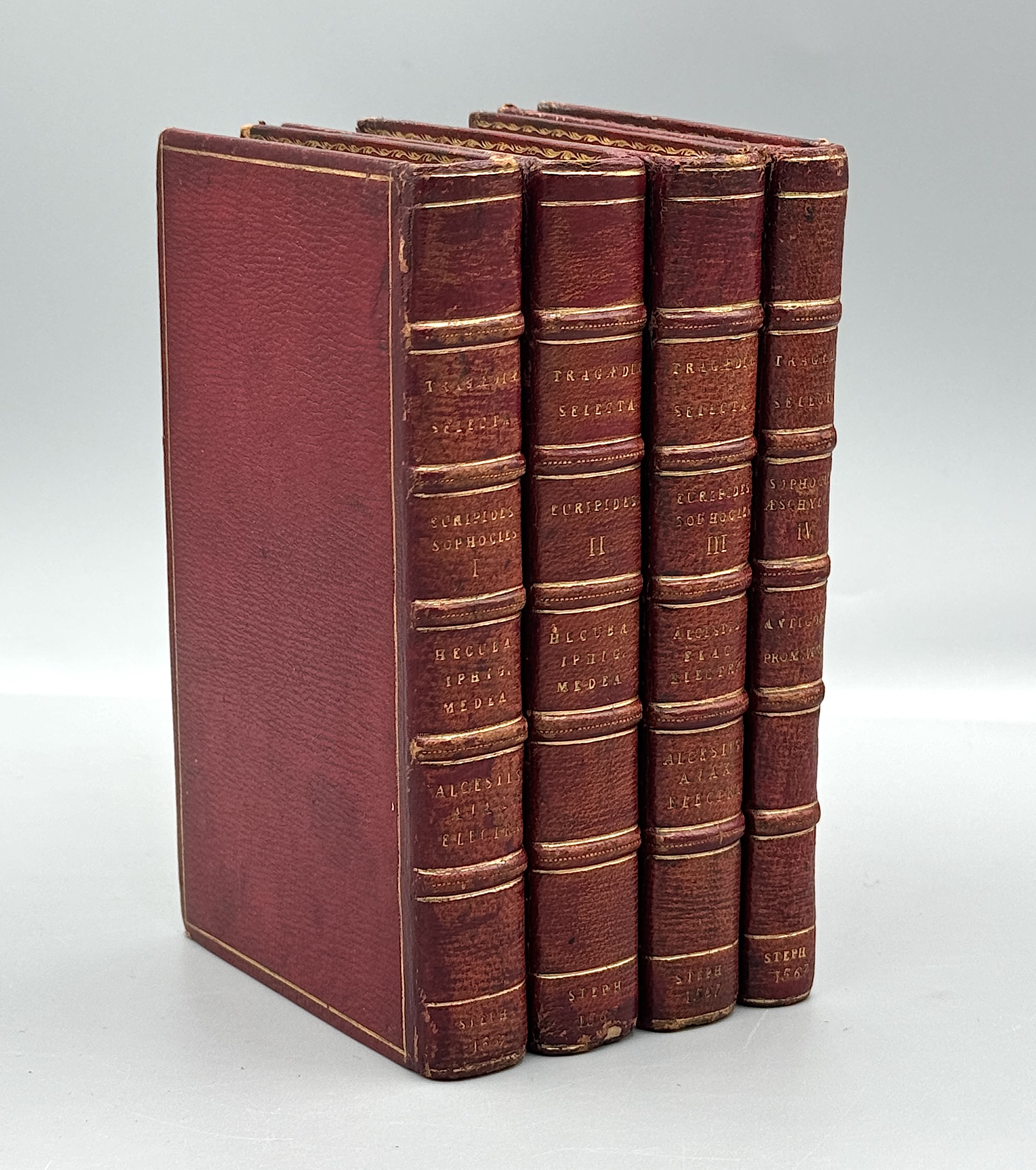


2 parts bound in 4 volumes, 16mo: (I) (2) ff., 379 p., 2 blank leaves; (II) p. 1–383 (p. 384 blank); (III) p. 385–735 (p. 736 blank); (IV) p. 737–955. Bound in early 19th-century red long-grain morocco, gilt fillet borders on the boards, spines with raised bands and gilt decorations, gilt dentelles, all edges gilt, blue endpapers and doublures (spines sunned, light rubbing to spines, hinges, corners, and boards; minor stains on boards, scattered light foxing, slightly trimmed margins).Dimensions: 12.6 x 7.1 cm.
Provenance
Annotated by a contemporary reader shortly after the publication of the book.
References: Renouard, Estienne, 130, no. 5. Schreiber, The Estiennes, 1982, no. 169.
Languages of annotations: Latin; Greek (a few words).
“A pocket edition for the ‘common reader’ of eight Greek tragedies” (Schreiber)
This edition, prepared by Henri Estienne and beautifully printed in small Greek, Roman, and Italic types, includes: Prometheus by Aeschylus, Three tragedies by Sophocles (Ajax, Electra, Antigone), Four tragedies by Euripides (Hecuba, Iphigenia at Aulis, Medea, Alcestis).
Each tragedy is presented with the Greek text alongside two Latin translations: a prose “word-for-word” version opposite the Greek text and a versified translation following it. The versified translations are by Erasmus, Melanchthon, Joachim Camerarius, Buchanan, and Georg Rattaler. However, no versified translation is included for Prometheus.
The Euripides volume is particularly notable as it constitutes the only edition of Euripides published by Henri Estienne, who never produced a standalone edition of this author. This gap was only filled by his son Paul in 1602.
Annotations Focused on Euripides, Especially Erasmus’ Translation of Iphigenia
The reader’s annotations are concentrated in the Euripides volume, particularly in Erasmus’ Latin translation of Iphigenia, which he has densely annotated. Additional notes follow in the general discussion of tragedy and comedy appended to the text. There are also a few notes on Medea in Buchanan’s translation. The other volumes are unannotated or sparsely marked.
The annotator extracts and reformulates striking or gnomic expressions from the text, such as: “The condition of mortals is that nothing is happy on all sides” (Mortalium conditio, nihil ab omni parte beatum, Vol. I, p. 50). “The terrifying visions of the night” (visa nocturna terrifica, Vol. I, p. 9). He notes realia, such as the Greek custom of greeting by clasping hands (salutandi mos apud Graecos, Vol. I, Iphigenia, p. 71). The reader also comments on key mechanisms of tragedy, such as:”The beauty of Helen was detrimental to her and her kin…” (Forma Hel<enae>et sibi et suis esse detrimentum…, Vol. I, p. 53). The annotator elucidates Greek terms, for example: “Suffocating heat” (gorgicôn toasthôn vehementes aestus, p. 66). He also provides references to classical works, such as: A note on the winged Fama (alis fama, p. 64) referring to Book IV of the Aeneid (Forma alata/ Vide Aeneidos 4°).
A Remarkable Annotated Copy Bound in Elegant Long-Grain Morocco
Offered by Librairie Nicolas Malais
$2,500
To purchase, contact librairie–nicolas@orange.fr
Leave a Reply