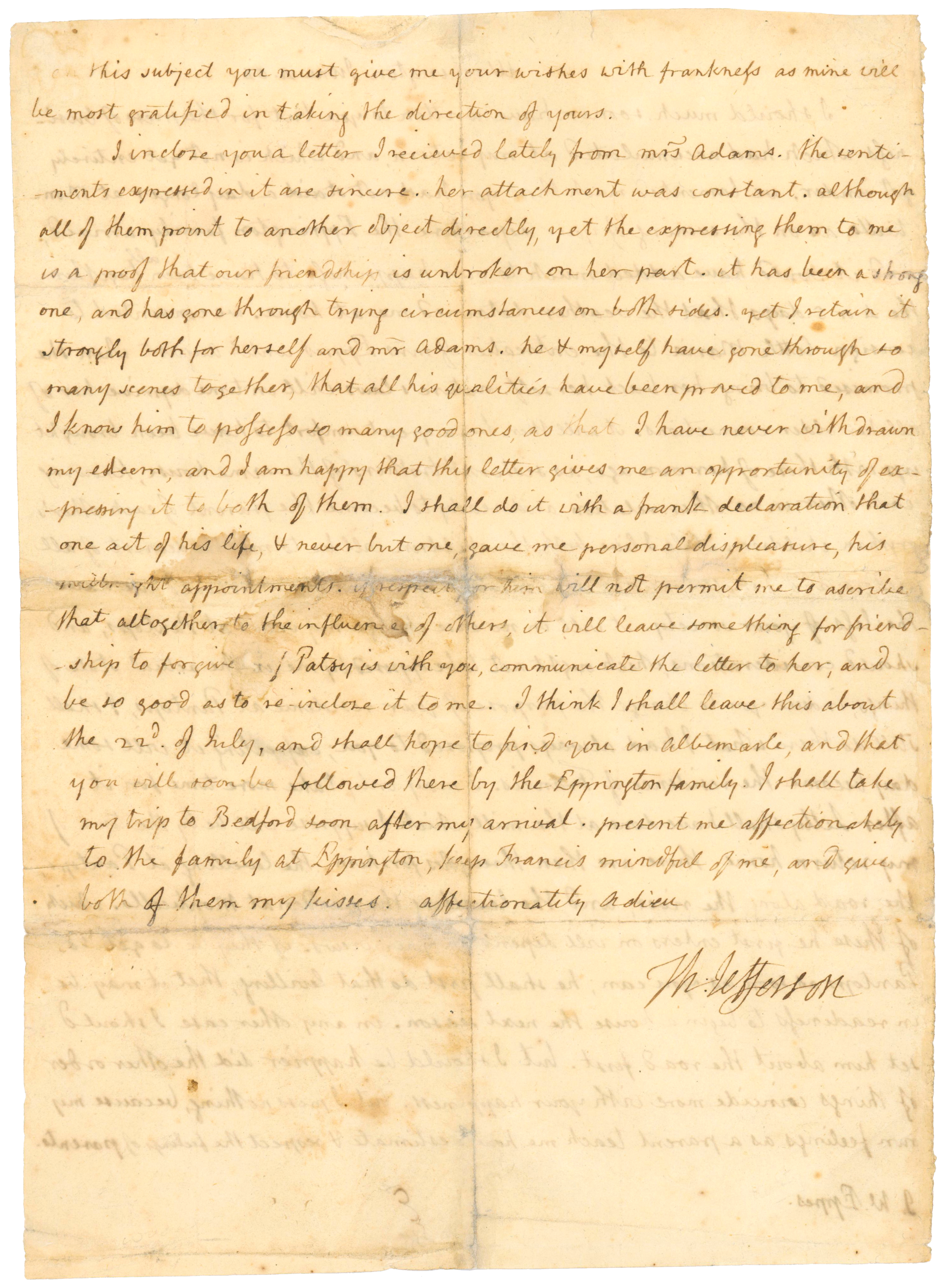


A remarkable, poignant letter from Jefferson’s presidency, prematurely anticipating reconciliation with his predecessor and longtime compatriot, though he still holds one grudge.
“He & myself have gone through so many scenes together…that I have never withdrawn my esteem, and I am happy that this letter gives an opportunity of expressing it to both of them. I shall do it with a frank declaration that one act of his life, & never but one, gave me personal displeasure, his midnight appointments. A respect for him will not permit me to ascribe that altogether to the influence of others, it will leave something for friendship to forgive.”
After the death of his daughter, Maria Jefferson Eppes, Jefferson assures his son-in-law that he will remain part of the family and advises him on the upbringing of the now motherless infant Maria. He discusses the continuing renovations of Monticello and neighboring Pantops, which Jefferson had given Maria as her dowry in 1797.
The “midnight appointments” were made by John Adams in the hours before he departed the presidency in 1801. Jefferson felt that Adams should have allowed the vacancies to remain for him to fill as the incoming president. He and Secretary of State Madison chose not to deliver the commission of one appointee, William Marbury, which had been accidentally misplaced. This decision led to the case of Marbury v. Madison, which Chief Justice John Marshall, appointed by Adams and an enemy of Jefferson, used to establish the doctrine of judicial review.
Abigail Adams had been a surrogate mother to the late Maria (“Polly”) Jefferson, who stayed with the Adamses in London in the mid-1780s. Despite receiving a condolence note from Abigail, Jefferson was wrong in thinking that she had changed her feelings towards him, and that his letter would clear the air. Instead, it provoked a scathingly frank letter from Abigail about her own resentments.
It was not until July 15, 1813, that John Adams directly reached out to Jefferson, writing that “you and I ought not to die until we have explained ourselves to each other.” That message began a remarkable series of letters that lasted until death claimed them both on July 4, 1826—the 50th anniversary of the Declaration of Independence.
THOMAS JEFFERSON. Autograph Letter Signed as President, to John W. Eppes, June 4, 1804, Washington D.C. 2 pp., 7¾ x 10 in.
Offered by Seth Kaller
To purchase, contact seth@sethkaller.com
Leave a Reply