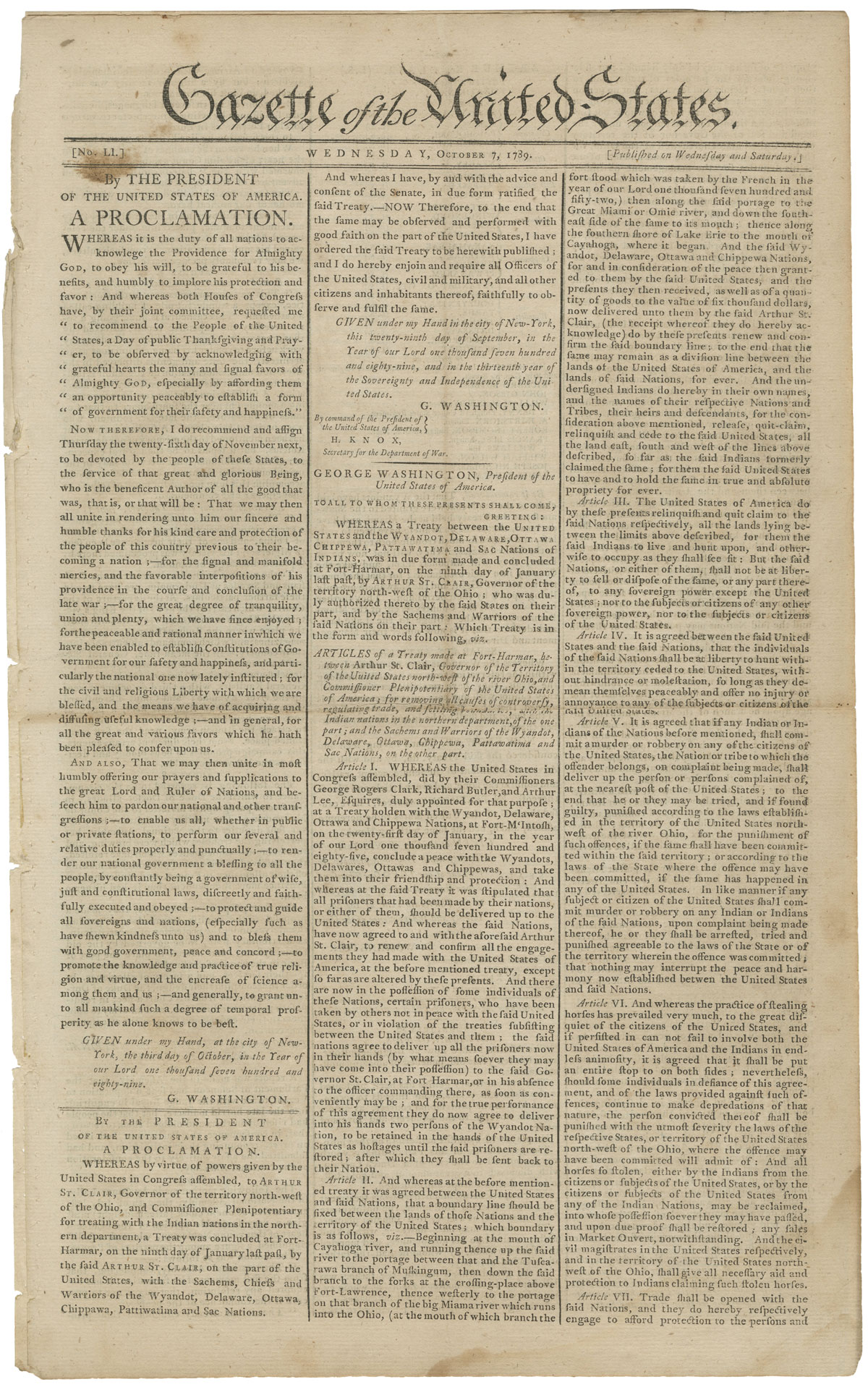

In the musical HAMILTON, King George III warns the Patriots, “I will kill your friends and family to remind you of my love.” Lin Manuel Miranda thus captured a reality of thousands of years of human history: governments existed for the sake of the rulers. This Thanksgiving Proclamation shows that America was meant to be different.
“ for the peaceable and rational manner in which we have been enabled to establish constitutions of government for our safety and happiness… for the civil and religious liberty with which we are blessed; and the means we have of acquiring and diffusing useful knowledge”
On September 25, 1789, as the momentous first Federal Congress drew to its close in New York, the new national capital, Representative Elias Boudinot introduced a resolution calling on President Washington to “recommend to the people of the United States a day of public thanksgiving and prayer.” A leading opponent, Thomas Tudor Tucker, noted that the people “may not be inclined to return thanks for a Constitution until they have experienced that it promotes their safety and happiness.” He also argued that it was a religious matter and thus proscribed to the new government. Regardless, the House passed the resolution — one of their last pieces of business before completing the proposed Bill of Rights. The Senate concurred three days later, and a delegation was sent to meet the President. Washington, who had anticipated the question in a letter to James Madison a month earlier, readily agreed.
This often-overlooked founding document set forth a statement of values and purpose for the new republic with “wise, just, and constitutional laws, discreetly and faithfully executed and obeyed…”
The Proclamation is religious, though not denominational, consistent with Washington’s belief in a God who superintended the universe and to whom people owed devotion and responsibility as a matter of personal faith, separate from any governmental influence. On the appointed day, Washington attended St. Paul’s Chapel, noting in his diary that the day was “inclement and stormy,” and few others attended. He also gave $25 to relieve the poor and donated beer and food to the city’s imprisoned debtors.
This issue also prints the Treaty of Fort Harmar between the United States and the Wyandot, Delaware, Ottawa, Chippewa, Potawatomi, and Sac Indian nations. A report from London about an “African Genius”. And a report on the proceedings of Congress, including an act to suspend part of the Tonnage Duties Act.
[GEORGE WASHINGTON.] Gazette of the United States. October 7, 1789, New York, N.Y., 4 pp., 9½ x 14¾ in. The full text of the proclamation on page 1.
Offered by Seth Kaller
$35,000
Leave a Reply